Workflow, context gap, baseline, target, measurement method, acceptance owner, and decision threshold.
Enterprise AI evaluation and production readiness
Know what must be true before AI enters the workflow.
ForgeNine defines and tests the business, source, technical, security, usability, and operating evidence needed for a release decision. The standard applies to the system being built; it is not a claim that evidence exists for an unstarted engagement.
Discuss one high-value workflowFour proof layers
Review what each layer must answer.
Examples are sanitized structures, not fabricated customer outcomes, implied endorsements, or guarantees.
Task-specific tests, source support, pass criteria, failure analysis, performance, and cost evidence.
Identity, permissions, lineage, data boundaries, approvals, and safe-failure paths.
Observability, incidents, rollback, training, and a client-owned improvement loop.
Reviewable examples
See evidence, including its limits.
These sanitized records come from the Sparks engineering repository. They demonstrate ForgeNine's working discipline; they are not customer outcomes or guarantees.
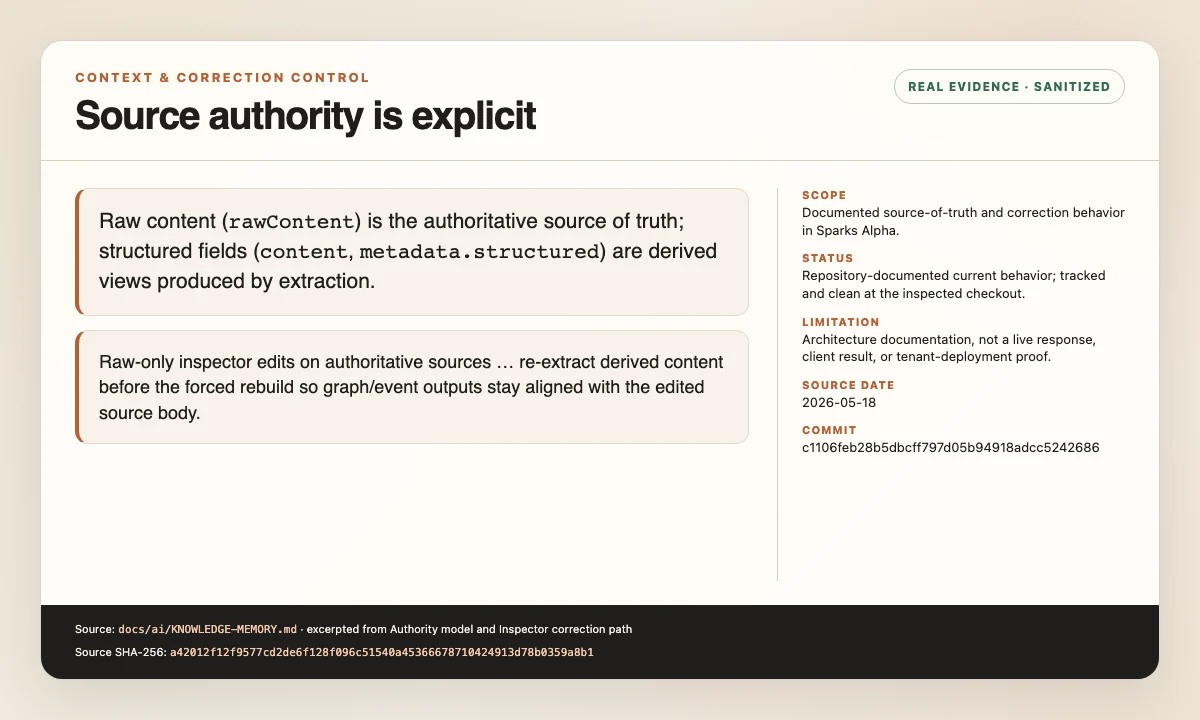
Repository documentation inspected at commit c1106feb on 2026-08-01. This supports a documented authority model—not a live response, customer result, or deployment claim.
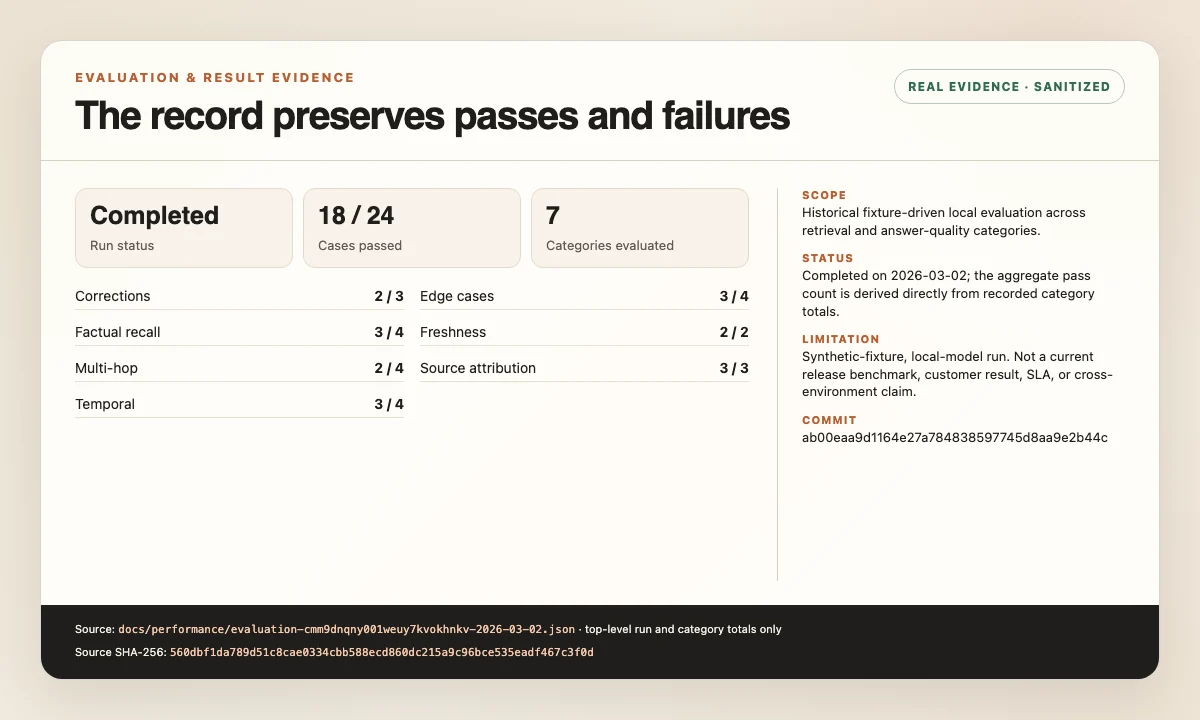
Completed 2026-03-02 using synthetic fixtures and a local model. It demonstrates visible passes and failures; it is not a current benchmark, SLA, or cross-environment result.
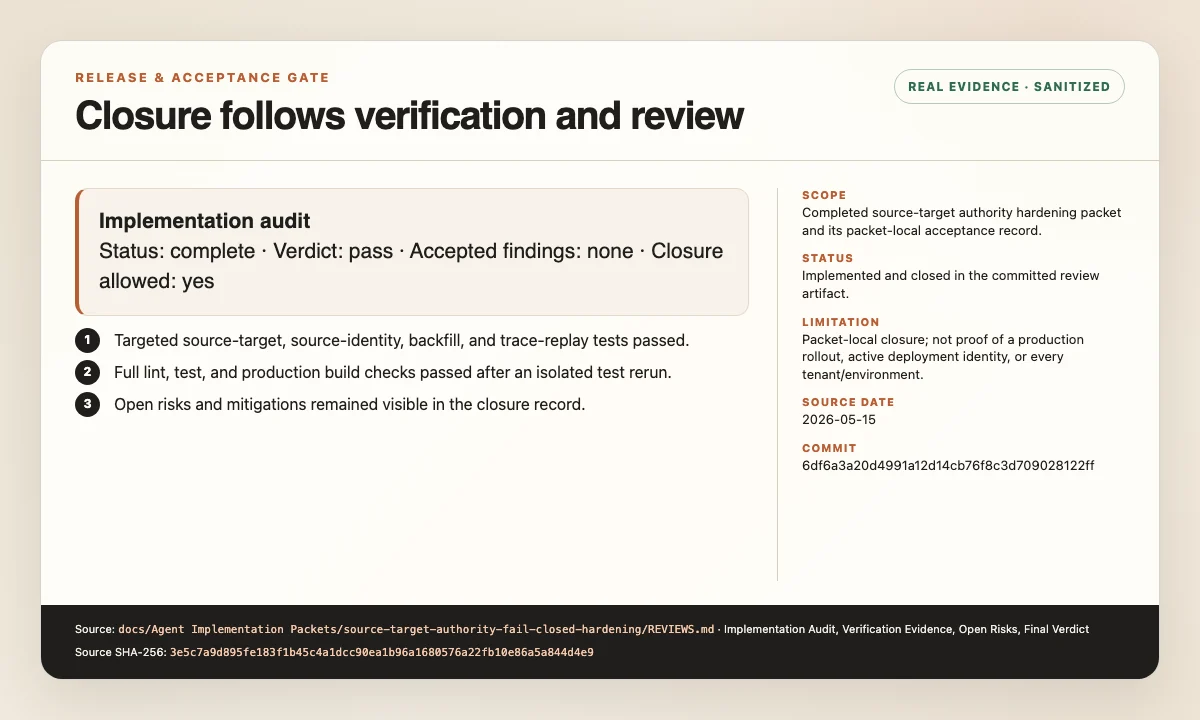
Packet-local review committed 2026-05-15. It demonstrates verification and risk-retention discipline—not a production rollout or active deployment identity.
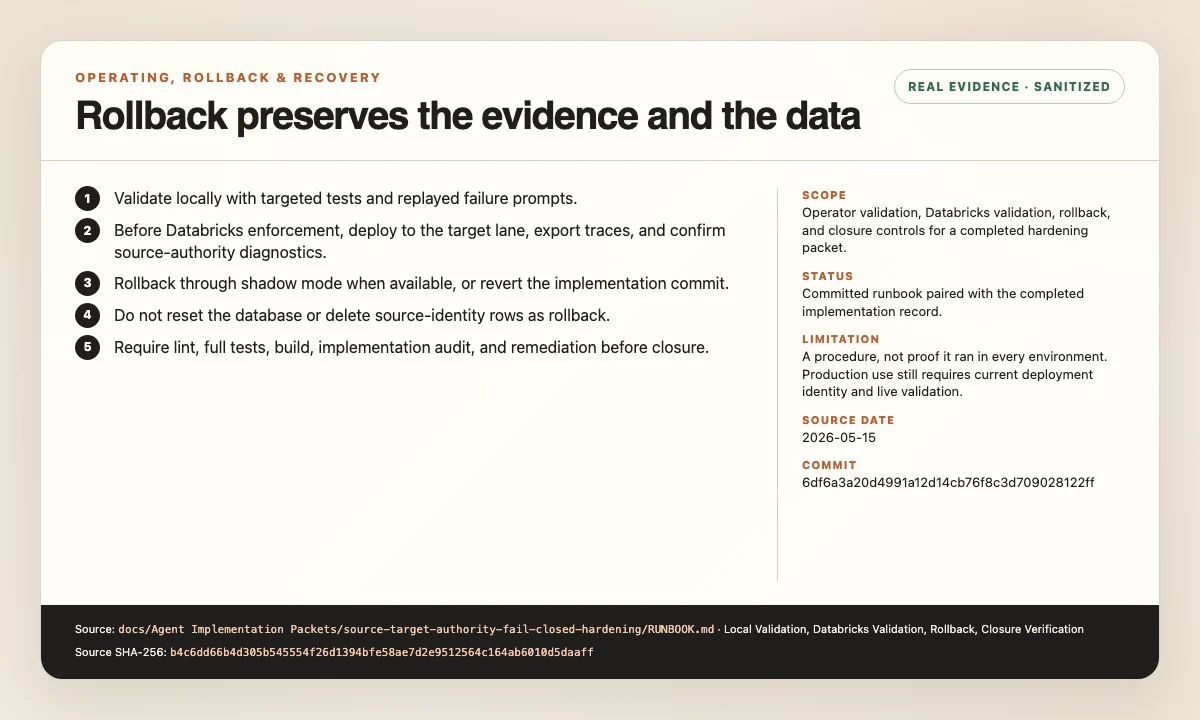
Committed runbook dated 2026-05-15. It documents a recoverable procedure; it does not prove execution in every environment.
Architecture receipts
The evidence package grows with the system.
Context, controls, and results stay versioned, attributable, and connected to release decisions.
Context map
Business definitions, events, decisions, experts, sources, and uncertainty
Data and knowledge contract
Authority, quality, schema, lineage, permissions, and recovery
Evaluation scorecard
Task tests, source support, regressions, failures, cost, and latency
Control map
Identity, access, boundaries, approvals, audit, and safe failure
Release gate
Version, environment, acceptance, rollback, and sign-off
Operating runbook
Dashboards, incidents, ownership, training, and improvement
Claim control
No invented metrics. No unexplained answers.
Public statements and system outputs are held to the same discipline: supported now, environment-dependent, or excluded until evidence exists.
- Supported: backed by current, reviewable evidence
- Environment-dependent: verified before commitment
- Uncertain: surfaced for human review
- Excluded: unsupported ROI, scale, partner, or customer claims
Apply the standard to a real workflow
Define the evidence your release decision requires.
Bring one high-value workflow, its approved sources, decision owners, and operating constraints for a fit review.